
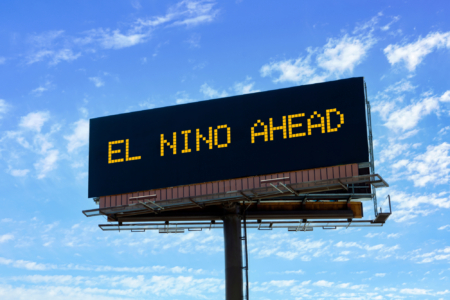
This submission will be a little different from my previous ones. In the past, I have focused on trade, trade policy and politics. This time, I am putting on my well-beaten hat to discuss El Niño and its potential impact while sitting in temperatures that feel like hell’s front porch here in Missouri.
El Niño is a naturally occurring climate pattern in which sea surface temperatures across the central and eastern tropical Pacific Ocean become warmer than average. This warming causes Pacific trade winds to weaken or reverse, pushing warm water toward North and South America and altering atmospheric circulation. The resulting weather disruptions can range from severe drought in some regions to excessive rainfall and flooding in others.
El Niño will not affect every country equally, but Asia could be especially hard hit. Rice and feed grains are among the commodities facing the greatest risk.
The U.N. Food and Agriculture Organization sees elevated agricultural drought risk extending from Pakistan and India through Myanmar, Thailand, Cambodia and Vietnam and eastward into the Philippines, Indonesia and Timor-Leste. This region includes some of the world’s largest rice producers, exporters and importers. Production losses across several countries or export restrictions imposed in response could quickly tighten the global rice market.
Corn could experience a two-sided impact. If drought reduces Asian corn production, countries with expanding livestock and poultry industries, including the Philippines and Vietnam, may need to import more feed grains. At the same time, heat and water shortages could increase livestock production costs and further pressure domestic feed supplies.
No one wants to see drought, but weather disruptions do create market opportunities. If conditions become as severe as projected, U.S. grain and oilseed producers could benefit from:
-Increased corn or sorghum demand from feed-deficit markets such as the Philippines and Vietnam.
-Stronger soybean and soybean oil prices if drought reduces palm oil production.
-Additional Asian demand for soybeans, soybean meal and dried distillers grains.
-Importers purchasing earlier than usual to secure supplies before conditions deteriorate.
To determine how serious the effects are becoming, I would monitor several indicators:
-Continued rainfall suppression over Indonesia through October and November.
-Indian monsoon deficits in major rice, sugar cane and maize regions.
-Falling reservoir levels in India, Thailand, Vietnam and the Philippines.
-Delays in Indonesian rice planting.
-Lower Mekong River levels and increasing salinity in Vietnam.
-Indian restrictions on rice or sugar exports.
-Unusually large rice tenders from Indonesia or the Philippines.
-Successive USDA reductions to Asian rice, palm oil or corn forecasts.
-Requests from Asian feed manufacturers for tariff relief or expanded grain imports.
With the U.S. harvest approaching or already beginning in some areas, it would not surprise me to see Asian importers place orders early to get ahead of potential El Niño-related production losses and price increases.
Brent Boydston is the founder of Ag Center Solutions, advising clients on government policy, trade, and foreign market development. He previously served as chairman of the U.S. Grains Council, leading efforts to expand global markets for U.S. grains and ethanol. Before that, he was the Corn, Cereal Grains, and Digital Agriculture lead at Bayer Crop Science, managing key industry relationships. His experience also includes roles at the Colorado Farm Bureau and on Capitol Hill, where he worked on major agricultural and trade policies, including the 2008 Farm Bill and the Colombian Free Trade Agreement. Boydston holds degrees from Kansas State University and Colorado State University and comes from a multi-generational farming family in Kansas.