
At first glance, another article about byproducts may seem unnecessary. Haven’t we already covered this topic extensively?
Building on many previous discussions, this article moves beyond established practices to identify next-generation strategies for improving stillage processing, economics and utilization. Stillage and other distillery byproducts have the potential to evolve from waste streams into valuable coproducts within integrated agricultural systems. In this article, I will discuss next-generation opportunities for fuel ethanol plants, beverage distilleries and livestock producers and highlight strategies for improving coproduct value, system integration and economic performance.
Distillery byproducts, including stillage, wet distillers grains (WDG) and dried distillers grains with solubles (DDGS), are well established as feed ingredients globally. They are secondary revenue streams for many alcohol producers. But many distilleries still put stillage down the drain and pay municipal fees. Many publications have clarified byproduct composition ranges, handling challenges and baseline utilization in livestock diets. The industry must now move from understanding these coproducts to implementing and optimizing value-recovery strategies. This article focuses on what comes next: how alcohol plants can improve processing efficiencies, reduce costs, enhance coproduct value and better integrate with livestock systems while addressing economic and environmental constraints.
While the fundamental processing concepts are similar across beverage alcohol and fuel ethanol production, important differences exist. Corn ethanol facilities generally operate at larger scales with more consistent feedstocks and coproduct compositions, whereas beverage distilleries often process diverse mash bills and smaller volumes. As a result, optimization strategies may differ between sectors, even though the underlying goals of value recovery, nutrient utilization and wastewater reduction remain the same.
What Do We Currently Know?
- Stillage contains recoverable solids with high feeding value.
- Separation technologies reduce wastewater loading and create coproduct streams.
- Wet products preserve nutritional value but have logistical and storage limitations, including a maximum storage life of five days during summer.
- Drying expands market reach but increases energy costs and requires storage and loadout equipment.
- Livestock, particularly ruminants, can efficiently utilize distillers grains, as can swine and poultry.
- WDG often provides the best balance between nutritional value and processing costs where local markets exist.
- DDGS markets are well established internationally through the corn ethanol industry.
- Nutrient composition and feeding value are generally more predictable in large corn ethanol facilities than in beverage distilleries using variable mash bills.
How can producers consistently and economically capture the inherent value of these coproduct streams?
The key constraint is economics. This ultimately determines stillage management decisions. Key cost drivers include:
- Energy use, especially for drying.
- Transportation distance to livestock farms.
- Wastewater treatment and surcharges, which many companies pay because disposal is their chosen management method.
- Capital investment in separation and drying equipment, which I have discussed in previous articles.
- Increased labor requirements and operational complexity.
On the other hand, key revenue factors include:
- Feed value of WDG and DDGS. The value of DDGS closely tracks that of corn; WDG normally is worth about half as much.
- Local livestock demand. Many distilleries are located in urban settings, and local livestock markets may already be saturated with distillery byproducts. These products may, in fact, compete with those from nearby ethanol plants for livestock use.
- Nutrient concentration and consistency. Depending on the mash bills used, nutrient content may shift frequently, which is not beneficial for livestock feeding.
To truly capture the value in stillage and distillers grains, we must reduce cost variability and increase revenue predictability.
The most important shift will be treating stillage decisions as a dynamic optimization problem rather than a fixed processing pathway. Large fuel ethanol plants and some large beverage distilleries have already implemented advanced separation, evaporation and drying systems. But many still have work to do.
First, large plants should move toward flexible systems that can shift between WDG and DDGS production based on real-time economics, including energy prices, feed demand and freight costs. Second, advanced heat recovery, hybrid drying systems and integration with anaerobic digestion can significantly reduce net energy use and costs while improving the sustainability of beverage production. Third, rather than focusing solely on compliance, large facilities can maximize value recovery from wastewater through nutrient capture and biogas production. Fourth, plantwide sensor and monitoring systems, including those measuring total solids, biochemical oxygen demand and nutrient flows, can support predictive optimization models.
What About Small and Craft Distilleries?
These facilities often require different strategies because of scale constraints. For example, the development and adoption of low-cost, small-scale separation systems represent a major opportunity, as discussed in my previous articles.
Direct integration with nearby livestock producers should be prioritized to eliminate or reduce transportation and drying costs. This requires building relationships and trust among the various parties. But someone still has to transport the waste to the farm.
It’s important to note that even modest solids recovery can significantly reduce discharge costs by minimizing municipal surcharges. Craft distilleries should evaluate wastewater fees as a key component of their economic decisions. Shared infrastructure — such as regional drying, separation or digestion systems — may provide economies of scale for smaller producers. Similar models have been successfully implemented in regions where multiple distilleries or ethanol plants are collocated.
The Other Side of the Conversation: Livestock Producers’ Perspectives
Livestock producers have successfully used stillage and wet and dried distillers grains for many years, but further improvements are needed. For example, improved nutrient prediction models and real-time analyses could allow better diet formulations, especially given the diversity of mash bills used.
Systems for managing variability, including routine sampling and standardized analytical protocols, can help improve ingredient consistency and animal performance. Coordinated delivery systems for wet coproducts could expand utilization beyond facilities located within the immediate hauling distance of a distillery or ethanol plant. Managing phosphorus and nitrogen loading also continues to be a critical issue requiring integrated nutrient planning, especially in terms of the field application of manure.
There are many opportunities to integrate agricultural systems and achieve circularity. Some of those with the greatest potential include:
- Co-location of alcohol plants and feedlots so that shipping costs are practically eliminated.
- Closed-loop nutrient cycling systems resulting from co-location.
- Integration of renewable energy systems that use byproducts for energy. These typically include biogas from anaerobic digesters and the capture and use of waste process heat.
- Hybrid processing systems that combine feed, energy and bioproduct outputs.
These systems move beyond linear supply chains toward circular bioeconomies. They can improve a plant’s bottom line while appealing to consumer groups interested in more sustainable processing systems.
Several emerging technologies and opportunities may be worth considering.
Low-energy drying technologies are being introduced for new and existing drying equipment. Membrane-based separation systems can separate dissolved solids from liquid streams while using substantially less energy than centrifugal and drying systems. Methods for extending the shelf life of wet coproducts using preservative additives also are becoming more common.
Stillage can be fractionated into multiple value streams, including concentrated yeast, protein and lipid streams, fiber and other chemical streams. Soluble fractions also can be converted into high-value biochemicals through fermentation and other approaches. Any of these technologies could significantly expand the value of stillage beyond traditional feed markets.
There are still several key unanswered questions and critical research needs:
- How can the full value of wastewater streams be realized?
- How can small-scale separation technologies become economically viable?
- What are the most effective approaches for stabilizing wet stillage and wet grains?
- How should producers balance wet versus dried coproduct production under changing market conditions?
- What decision-support tools can best guide plant-level capital investments and operational strategies?
Example Break-Even Curves
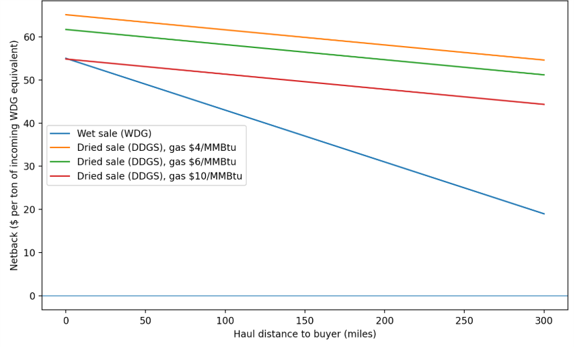
The following case study illustrates the economics of drying stillage into DDGS versus selling wet cake. These example calculations assume WDG at 65% moisture, DDGS at 10% moisture, a wet coproduct sale price of $55 per ton as-fed, a DDGS sale price of $185 per ton as-fed, wet hauling at 12 cents per ton-mile, dry hauling at 9 cents per ton-mile and a drying energy intensity of 1,400 Btu per pound of water removed.
Figure 1 compares the delivered netback from a wet sale with a dried DDGS sale across a range of delivery distances under multiple natural gas price scenarios. Together, these curves illustrate that the preferred coproduct pathway is highly sensitive to both fuel prices and local market geography.
Conclusion
The next phase of stillage and distillation coproduct utilization will be driven less by discovery and more by implementation, optimization and integration. Beverage distilleries, fuel ethanol plants and livestock operations all have opportunities to improve economic performance through flexible processing strategies, enhanced nutrient management and stronger system integration. By adopting data-driven approaches and embracing circular bioeconomy principles, these industries can unlock additional value from coproduct streams while improving sustainability and resource efficiency.