
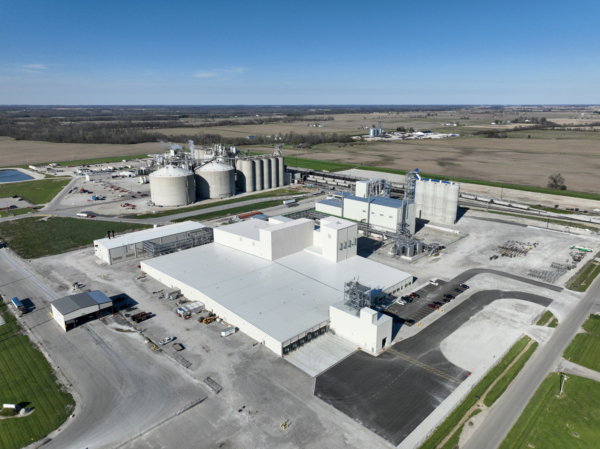
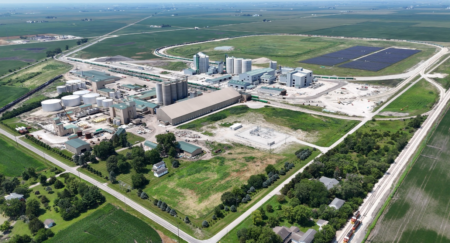
An aerial view shows Bunge’s new $550 million soy protein
concentrate facility in Morristown, Ind., alongside the company’s existing soybean crushing and refining operation. The new facility opened in May and is expected to process approximately 4.5 million bushels of soybeans annually.
Historically high soybean crush margins are being recorded by U.S. soy processors because of a government increase in renewable fuel volumes and higher energy prices caused by the blockage of the Strait of Hormuz.
The increased profits are leading to a large-scale expansion by soybean processors.
Soybeans processed for crude oil increased 11% in June this year compared with June 2025, according to the U.S. Department of Agriculture’s National Agricultural Statistics Service. U.S. soybean processors crushed more than 2.5 billion bushels of soybeans in 2025, a 7.4% jump from the prior year, according to the USDA.
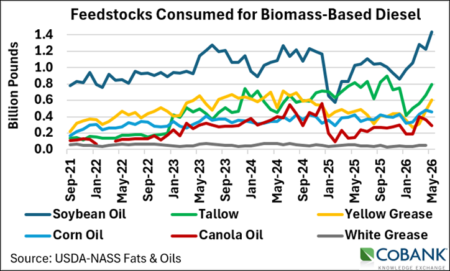
Tanner Ehmke, lead economist for grains and oilseeds at CoBank’s Knowledge Exchange research division, told Processing Journal that the historic increase in biofuel demand is behind the crush expansion. In March, he said, the U.S. Environmental Protection Agency increased the renewable volume obligation’s biomass-based diesel blending requirement by 67% for 2026 and 70% for 2027 over 2025 levels. “Soybean oil is the major feedstock that will be used to meet the requirement,” Ehmke stated, “currently accounting for 40% of all fats and oils used for renewable diesel or biodiesel production.”
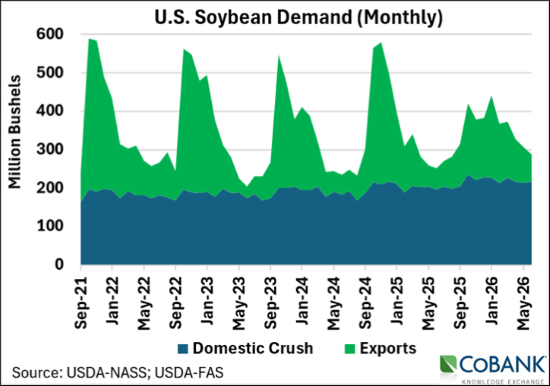
Ehmke said that for the remainder of 2026, the soybean crush pace will continue expanding at a more accelerated pace with the addition of the new capacity. “I’m currently figuring Q3 crush at 670 million bushels, up from 608 million last year,” he noted, “with Q4 crush climbing to about 760 million bushels, up from 687 million in Q4 2025.”
The faster crushing pace will help fill the void of any lost export demand because of U.S. trade policies, he remarked, but fully replacing lost exports will be very difficult. “For the marketing year to date (September to June), the U.S. soybean crush pace rose 285 million bushels over last year, but exports were down 350 million bushels. That’s a net loss of 65 million bushels in demand. Bear in mind, though, that the crop for this marketing year was 112 million bushels smaller than last year, so there were fewer bushels available for export.”
Here’s an in-depth look at three recently announced expansion projects, with information gleaned from comments to Processing Journal from the companies involved:
Bunge

Bunge, the world’s largest oilseed processor, has opened a new soy protein concentrate facility in Morristown, Ind., marking the first food-grade plant of its kind built in the United States in more than four decades, according to Brian Douville, Bunge’s vice president of emulsifiers and proteins.
Douville told Processing Journal that Bunge invested approximately $550 million in its state-of-the-art soy protein concentrate facility.
The new plant officially opened in May, he said, and is producing PurePro soy protein concentrates in powdered and textured formats. The facility is expected to process approximately 4.5 million bushels of soybeans annually.
“In the past, however, food and beverage manufacturers struggled with earthy flavors and dull colors common to plant protein ingredients,” Douville stated. “Bunge’s investment in new technologies solves these pain points by creating ultraclean-tasting and light-colored PurePro soy protein concentrates in scale and affordably.”
PurePro is offered in non-GMO and conventional formats and is intended for food, beverage, pet food and animal nutrition customers, he noted, including applications in processed meats, plant-based meats, bakery goods, snacks, beverages, pet foods and animal nutrition. The soy oil from the plant will be marketed to Bunge’s traditional oil customers.
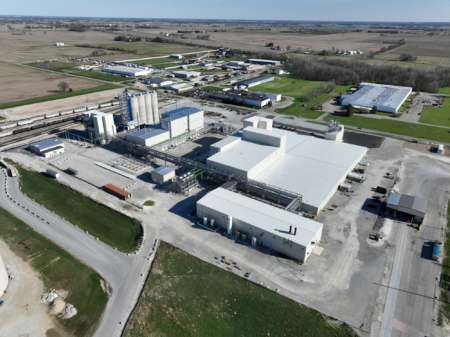
Douville noted that the new soy protein concentrate plant has been built adjacent to the crush and refining facility that Bunge has operated in Morristown since 1996 and includes soybean crushing, oil refining, soybean meal production, soybean hull production, soybean oil production and soy lecithin production. The Morristown, Ind., plant was expanded in 2004.
In addition to the new soy protein plant, Bunge acquired the soy protein concentrate, lecithin and soy crush businesses from International Flavors & Fragrances Inc. in March.
ADM
ADM is expanding its North American soybean crushing capacity at four of the company’s U.S. crush facilities to boost its annual oilseed crushing capacity by approximately 700,000 metric tons, which is the equivalent of more than 25 million bushels of additional demand.
ADM said it is “actively evaluating similar enhancements” at its other North American crush facilities because of strong demand for renewable biofuels in the United States. It has 22 crushing plants in North America, including joint ventures, the company told Processing Journal.
ADM did not release information about the cost of the initial investments that will take place at four of its U.S. crush facilities in Frankfort, Ind.; Deerfield, Mo.; Lincoln, Neb.; and Spiritwood, N.D. The improvements will be completed from mid-2028 to early 2029.
Gary McGuigan, president of ADM’s North American Ag Services and Oilseeds business, said strong demand is supported by U.S. biofuels policy. “By choosing to build on our existing footprint and adopting individualized enhancement plans for each facility, we’re ensuring that we are investing wisely and preserving flexibility while ultimately delivering a meaningful increase in capacity across our North American network,” he said.
The projects follow other recent investments to enhance ADM’s U.S. footprint, the company said, including upgrades at its Clinton, Iowa, corn facility and capacity expansions at its elevator in Optima, Okla.
Incobrasa

In Gilman, Ill., Incobrasa Industries has opened a second soybean processing plant adjacent to its existing plant that will bring its daily soybean processing capacity to 300,000 bushels a day at the two plants, according to Alex Fogarty, quality control and government affairs manager. Fogarty told Processing Journal that the expansion makes Incobrasa’s combined twin facilities in Gilman the single largest soybean extraction facility in North America.
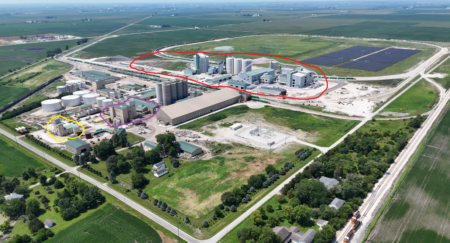

Construction of the new plant cost $250 million, Fogarty reported. The plant’s footprint is about 170,000 square feet, or just under four acres. When the new plant is running at full capacity, it will process 160,000 bushels of soybeans a day, adding to the existing plant’s capacity of 140,000 bushels a day.
Approximately 88% of the soy oil goes to biodiesel production at the company’s 75 million-gallon-a-year biodiesel plant, Fogarty noted. The remaining 12% is used as food-grade soybean oil.
By the end of October, the company plans to open a second biodiesel plant next to its current plant. When the new plant comes online, biodiesel production will more than double to 160 million gallons a year. That will make the Incobrasa facility in Gilman the largest single biodiesel plant in North America, according to Fogarty.
The company also has added a 50-acre solar power field at the Gilman site that supplies 5 megawatts of electricity. It plans to double its solar power capacity in the next few years to 10 megawatts.