
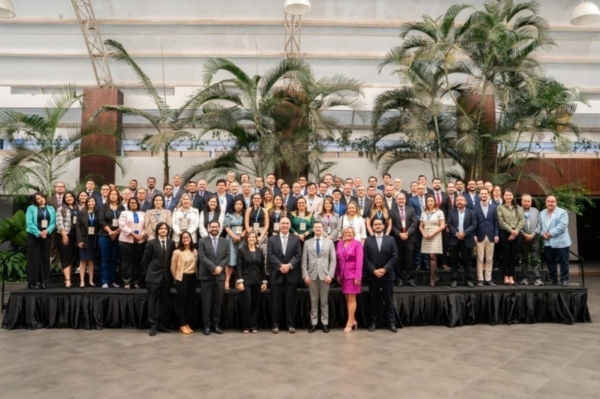
Photo credit: U.S. Grains & BioProducts Council.
Guatemala launched its E10 ethanol blending program in regular gasoline Aug. 22, marking a major milestone for the country’s fuel market and ethanol development in Central America.
The program follows years of regulatory, technical and commercial preparation and was developed through collaboration among public and private sector stakeholders, with support from the U.S. ethanol industry and the U.S. Grains & BioProducts Council.
The Guatemalan Ministry of Energy and Mines led the domestic implementation in coordination with ethanol producers, fuel importers, terminal operators, distributors, service stations and other participants throughout the fuel supply chain.
The U.S. Grains & BioProducts Council supported the transition with technical expertise, stakeholder engagement, workshops, conferences, trade missions and technical exchanges between Guatemalan representatives and the U.S. ethanol value chain. The efforts addressed policy and regulation, fuel quality, vehicle compatibility, infrastructure, storage and handling, blending, logistics and supply.
A key milestone was the Cultivando Energía 2026 Regional Seminar, held in Guatemala in March. The event brought together government and industry representatives and international experts from seven countries. U.S. Department of Agriculture Under Secretary for Trade and Foreign Agricultural Affairs Luke J. Lindberg and USGBC President and CEO Ryan LeGrand participated in the program, which coincided with high-level bilateral discussions with Guatemalan President Bernardo Arévalo on agricultural cooperation, U.S.-Guatemala trade and E10 implementation.
Before the commercial launch, the Ministry of Energy and Mines established an operational phase from June 30 through Aug. 21 to complete technical verifications and supply chain preparations. Storage and infrastructure conditions, blending and quality-control protocols and distribution logistics were addressed, while ethanol inventories were positioned for the launch.
On Aug. 22, terminals began dispatching E10 into the regular gasoline distribution system. Ethanol was blended at the terminal level before delivery to service stations. The retail transition occurred gradually as stations depleted existing conventional gasoline inventories.
By Aug. 25, about 75% of Guatemala's service stations were dispensing E10. The initial rollout proceeded with a stable fuel supply and continued coordination among participants throughout the value chain.
The program creates a new commercial opportunity for U.S. ethanol. Guatemala's gasoline market and E10 requirement are expected to generate significant ethanol demand that can be supplied through domestic production and imports.
Under the United States-Guatemala Agreement on Reciprocal Trade, signed earlier this year, Guatemala committed to endeavor to purchase at least 50 million gallons of U.S. ethanol annually. Premium gasoline could provide additional demand, subject to technical evaluations and a subsequent determination by the Guatemalan government.
Guatemala's E10 rollout also provides a model for other Central American countries considering ethanol blending. Its transition from policy and regulation through technical preparation, commercial supply and nationwide distribution offers practical experience in infrastructure, terminal blending, fuel quality, vehicle compatibility, supply planning and coordination among industry stakeholders.
Source: U.S. Grains & BioProducts Council, "Guatemala Begins E10 Blending Mandate, Opening New Market Opportunity For U.S. Ethanol"