
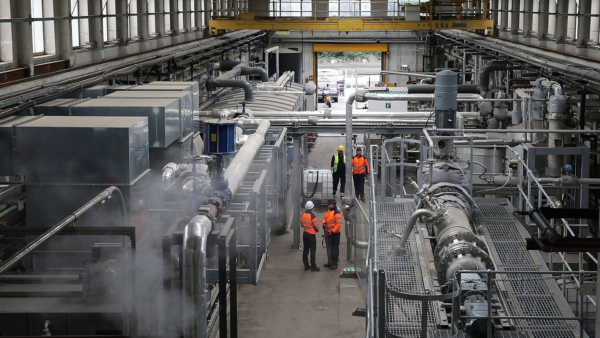
Photo credit: Nova Pangaea Technologies.
Nova Pangaea Technologies has completed endurance trials of its technology for producing ethanol and biochar from waste biomass, further validating its potential to supply feedstock for carbon-negative sustainable aviation fuel.
The trials at the company's demonstration plant on Teesside, England, demonstrated continuous, stable operation during production runs of up to 72 hours and achieved yields above target levels.
The results come as Nova Pangaea prepares to raise funds for its first commercial-scale plant and as the aviation industry looks to expand sustainable aviation fuel production beyond its current reliance on waste oils and fats.
Nova Pangaea is working with British Airways and LanzaJet on Project Speedbird, a UK government-supported initiative to produce carbon-negative aviation fuel from local waste biomass. Under the project, Nova Pangaea plans to construct four UK facilities to produce bioethanol from local waste streams for upgrading into SAF through LanzaJet's Alcohol-to-Jet biorefinery.
The company's REFNOVA process converts waste biomass and residues, including wood chips, sawdust and wheat straw, into ethanol for use in SAF and renewable diesel production. The process also produces biochar, a co-product that permanently captures carbon and enables the overall process to achieve negative carbon emissions.
The latest trials used softwood residues from timber processing, with multiple production runs processing up to 3 metric tonnes of feedstock per day.
The trials build on smaller-scale testing conducted in early 2025 that demonstrated the process could operate outside a laboratory environment. Additional trials are planned for next year to further refine the design of the first commercial-scale plant.
Nova Pangaea's technology is intended to expand the range of feedstocks available for SAF production and help address potential future shortages. Under UK and European Union rules, airlines are required to use increasing amounts of SAF, with requirements rising from 2% to as much as 70% by 2050.
Most SAF currently is produced from used cooking oil, a feedstock with limited availability that is not expected to meet future demand.
According to the International Air Transport Association, Europe and the UK are expected to have enough waste biomass available in 2030 to produce about 30 million tonnes of SAF, equivalent to European SAF targets for 2050.
Nova Pangaea has raised more than £21 million from investors, including International Airlines Group, PXN Ventures, Mercia Ventures and the first Northern Powerhouse Investment Fund. The company also has received UK government grant funding through the Advanced Fuels Fund competition.
Source: Nova Pangaea Technologies, "Sustainable aviation fuel pioneer completes successful trials"