
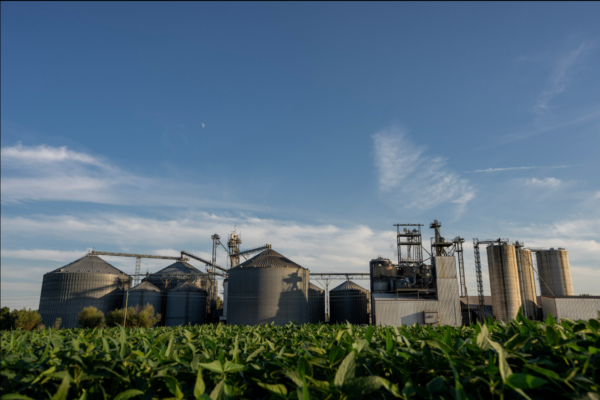
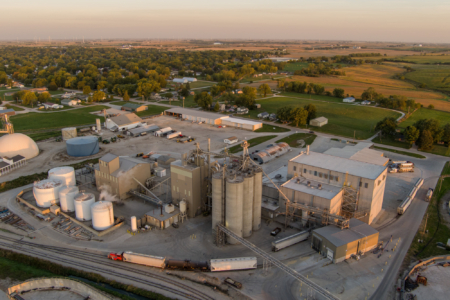
In 2023, White River Nutrition purchased the soybean processing facility at Seymour, IN from Benson Hill. Photos courtesy of White River Nutrition.
White River Nutrition is improving and expanding its oilseed processing facilities in Iowa and Indiana while it raises money to build a soybean processing plant in Nebraska. When it was founded in October 2023, White River purchased a soybean processing plant in Seymour, IN from Benson Hill, Inc. On Feb. 13, 2024, White River acquired Benson Hill’s food-grade soybean processing facility in Creston, IA.
Following the Creston purchase, the company changed its name from White River Soy Processing to White River Nutrition. “The new name more accurately reflects our mission to provide the highest quality soybean products for better nutritional outcomes and reflects the wider range of nutritional food and feed products that we are now able to offer after the acquisition,” according to the company, which has headquarters in Omaha, NE.
White River intends to grow its portfolio of assets in soybean and other oilseed processing through acquisition as well as greenfield development. “With a commitment to excellence in production and safety for our employees,” the company states, “our team leverages decades of experience in soybean processing and is driven to produce the highest quality vegetable protein meal and oil for better nutritional outcomes. We are passionate about building lasting partnerships with farmers, contributing to our communities, and delivering superior soybean products to our customers.”
Although its name has changed, “The company’s focus remains on achieving superior outcomes in soybean proteins, primarily soybean meal and soybean white flake to meet the relentlessly growing demand from a hungry global population,” says Walter Cronin, co-founder and president of White River Nutrition.
While it works to improve its existing plants in Indiana and Iowa, White River is raising funds to build a new plant in western Nebraska. In December 2023, it was announced that the North Platte Area Chamber & Development Corp. had granted White River exclusive development rights for a best-in-class oilseed processing plant at its industrial site outside of Hershey, NE. “We are currently contemplating a standard 3,000-ton industrial-sized soybean processing plant as well a 1,000-ton multi-seed specialty plant” at the Nebraska site, Cronin states. The final decision to build the plant “will be made in conjunction with investor requirements,” he adds. “When the capital raise is completed, then construction will begin immediately.”
The cost of the project would be $350 million for the 3,000-ton facility and $125 million for the 1,000-ton multi-seed facility. In addition to soybeans, White River Nutrition contemplates processing canola, sunflowers, and camelina in the future, Cronin says, and will consider growing its processing capacity through additional acquisitions.
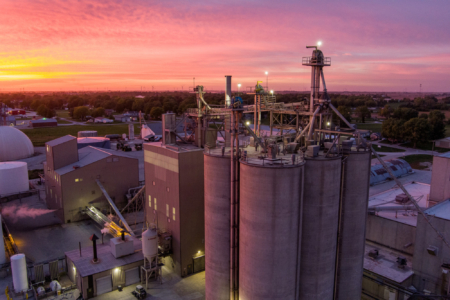
Creston Plant
At the Creston plant, White River intends to expand its offerings by introducing textured vegetable protein and other soybean products. “We currently own the equipment, which was acquired with the purchase of Benson Hill Ingredients, to produce these products,” Cronin notes.
“White River, in conjunction with the local plant management team, has successfully optimized plant operations to achieve higher operating metrics. These higher metrics did not require adding to the plant’s capabilities.”
The company also is considering doubling the packaging capacity at the Creston plant by purchasing additional machinery. The Creston plant’s current production process consists approximately of 70% genetically modified (GM) soybeans with the remaining 30% of production coming from non-GM soybeans. “We continue to consider multiple opportunities in superior protein meal and flake production for both non-genetically modified and genetically modified products,” he says.
Built in 1998 by local farmers, the plant was acquired by ZFS Creston, LLC in 2018 and optimized for non-GM production. In 2021, it was purchased by Benson Hill to support high-protein soybean ingredient production.
The plant specializes in producing high-quality soybean meal, soybean oil, and food-grade soybean white flakes, flour, and grits from locally grown soybeans. It is capable of processing bulk, standard soybean meal and soybean oil, as well as degummed soybean oil. It is one of only five plants in the United States that can produce defatted soybean flake, soybean flour, and soybean grits.
Standards and certificates include SQF NON-GMO Project Verified FOODCHAIN ID, Certified Kosher Halal Food Processing License, and Good Manufacturing Processes (GMP) +3. The Creston plant has 50 full-time employees. There have been no significant changes to the staff of the plant since its acquisition by White River, and it has had a more than 90% employee retention rate.

Seymour Plant
The Seymour, IN plant produces vegetable protein meals and crude soybean oil for domestic and global markets from locally sourced non-GM and GM soybeans. It has delivered non-GM soy products to the Japanese market for more than 20 years, Cronin mentions, with soy oil and meal shipped via containers by truck to barge loading facilities on the Ohio River as well as facilities in Cincinnati, OH.
“White River continues to contemplate processing soy protein concentrate (SPC) with a yet-to-be named European partner at the Seymour facility,” Cronin tells Processing Journal. The SPC will be primarily marketed to domestic poultry and swine markets.
The plant was built in 1991 by Rose Acre Farms, the second largest egg producer in the United States.
In 2021, the plant was acquired by Benson Hill. There are 30 full-time employees. There have been no changes to the staff or the facility since its acquisition by White River, with more than 95% employee retention.
Standards and Certificates include food chain ID NGMO Global Standard Non-GMO Project Verified (in process of receiving) and GMP+ Kosher 4.
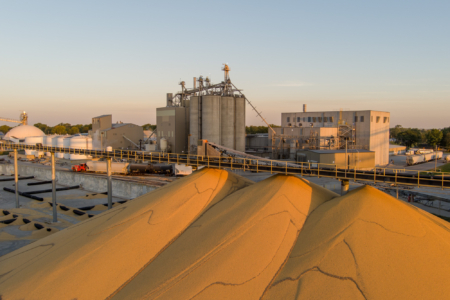
Hershey, NE
White River has an agreement for exclusive development of an oilseed processing plant at an industrial site with the North Platte Area Chamber & Development Corp. Developing soy processing at the site will allow White River the ability to move products domestically to the Intermountain West and West Coast markets, and access global markets via West Coast ports via truck and rail transportation modes, the company has said.
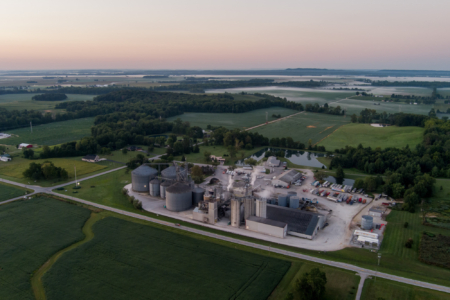
Agricultural Backgrounds
One of the corporate advantages cited by White River is the agricultural background of its owners, who have had experience in crop production, livestock production, grain warehousing, and grain processing in addition to soybean processing.
“Our investors remain comfortable with the two reliable investment themes that drive all agricultural projects globally,” says Cronin. “First, there will be more people in the world tomorrow than there are today because of global population growth and, second, the expanding global population will eat better, mostly with higher consumption of meat proteins.”
Cronin has 35 years of experience in grain, oilseed, protein meal, and vegetable oil trading, with a focus on risk management, including senior management roles at Green Plains Inc. before co-founding White River.
Among other, ag-related jobs, he has been a consultant at Bunge Ltd., a multinational grain trader and oilseed processor, and co-managed ag futures trading programs at Kottke Associates, a commodity trading advisor based in Chicago.
He frequently shares his oilseed market insights on LinkedIn. Writing on his LinkedIn account, Cronin said he thinks that the soybean market holds the promise of staging what he calls “a major bull market run.”
So far, in 2025, he stated: “Expansive demand for U.S. soybean meal both domestically and globally (exports) continues to surprise analysts to the upside. Meal demand continues to remain robust and predictable; record domestic and export demand continues to unfold. I believe that demand will allow the United States to achieve sequential record export growth.”
Soy oil prices are tied to U.S. biofuel policy, he noted, which is not yet solidified and makes predictions difficult. Another wild card, he stated, is the Trump Administration’s shifting tariff policies, which makes it difficult to assess the tariffs’ impact on soy prices.
Cronin, who was a Peace Corps volunteer in Kenya from September 1985 through December 1987, received a Bachelor of Arts degree from the University of Santa Clara in 1985.